Why your gut, brain and skin aren't separate, and why that matters for rosacea.
If you've been living with rosacea for a while, there's a good chance you've looked beyond your skin for answers.
Perhaps you've investigated your gut health, changed your diet, explored digestive issues or spent hours researching the relationship between inflammation and skin health.
The connection between gut health and skin has received increasing attention, and for good reason. But there's another part of this relationship that deserves more attention: the brain.
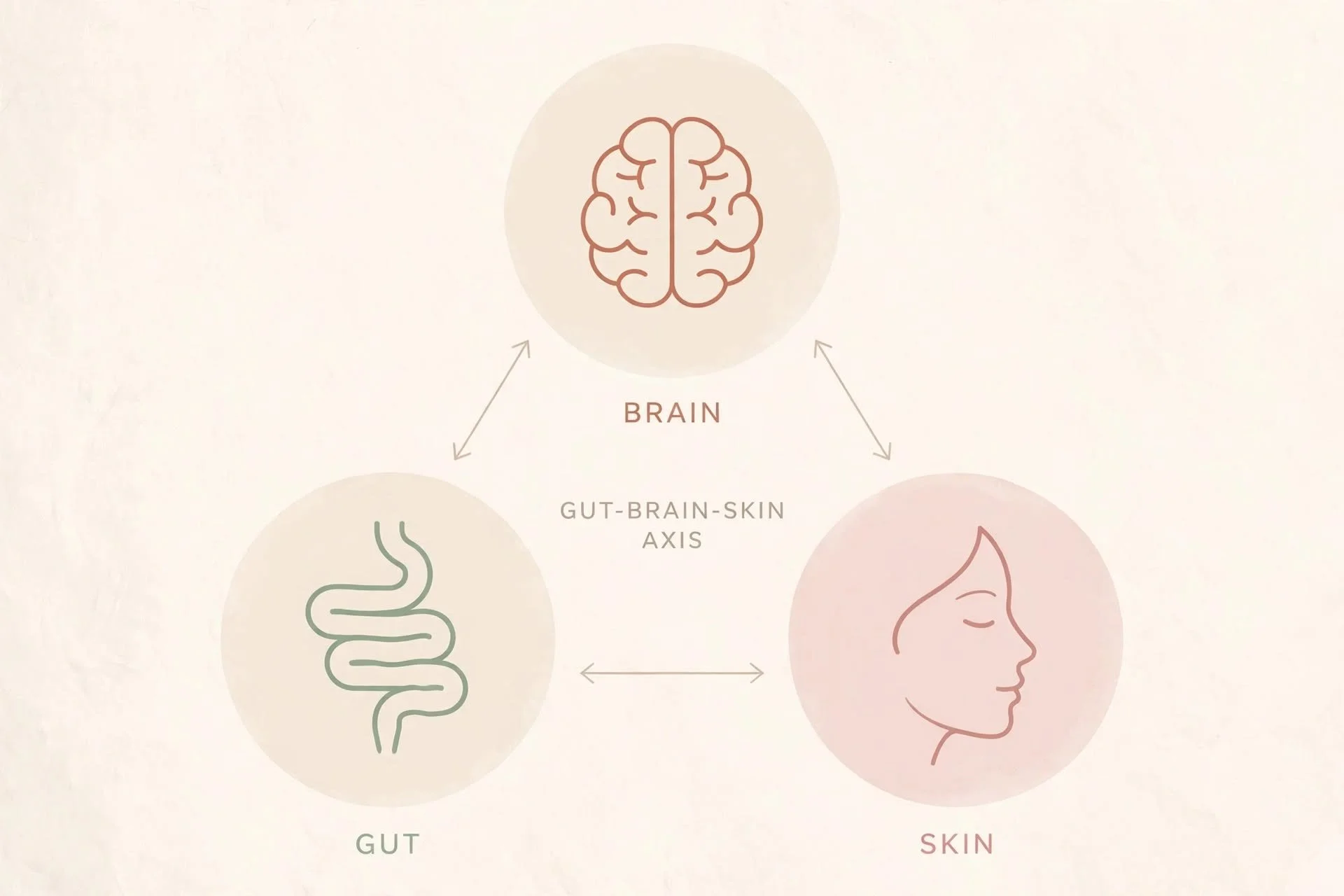
The gut, brain and skin are connected through a network of communication pathways. They don't operate independently, and signals between them can influence a range of processes throughout the body.
Researchers refer to this as the gut–brain–skin axis.
It's an interesting area of research, particularly when we're looking at a condition as complex as rosacea.
What is the gut–brain–skin axis?
The gut–brain–skin axis describes the communication between three interconnected systems in the body: the gut, the brain and the skin.
Rather than functioning as entirely separate systems, they communicate through neural, immune and endocrine (hormonal) pathways.
Importantly, this communication is bidirectional. Signals don't simply travel in one direction.
The brain influences digestive function, immune activity and the body's stress responses. The gut communicates with the brain through neural, hormonal and immune signalling. And the skin has its own network of sensory nerves and immune cells that respond to signals from within the body and the external environment.
These relationships are complex, but the underlying idea is relatively simple: what's happening in one system can influence processes in another.
This is the foundation of the gut–brain–skin connection.
The gut–skin connection: more than digestion
The relationship between gut health and skin health has received considerable attention in recent years.
One reason is the gut microbiome.
Your gut is home to trillions of microorganisms, including bacteria, fungi and other microbes. Collectively, these make up the gut microbiome.
These microorganisms play important roles in digestion, nutrient metabolism and immune function. They also produce substances that interact with cells and signalling pathways throughout the body.
The gut is also a major site of immune activity. The relationship between gut microorganisms and the immune system helps regulate how the body responds to different signals.
The skin has its own immune system, which plays an important role in maintaining the skin barrier and responding to potential threats.
Researchers are exploring how changes in the gut microbiome and immune signalling might influence inflammatory processes elsewhere in the body, including the skin.
This relationship is often referred to as the gut–skin axis.
What does this have to do with rosacea?
Rosacea is a multifactorial inflammatory skin condition. Its development and symptoms involve several interacting processes.
The gut microbiome and digestive health can also be part of this picture. Research is increasingly exploring how the gut communicates with the immune system and influences inflammatory processes that can affect the skin.
This doesn't mean gut health is a single cause of rosacea, or that addressing it alone will resolve the condition. Rather, it's one part of a much wider network of influences.
I explore the relationship between gut health and rosacea in more detail in my first article, Why Isn't My Rosacea Improving?.
The gut–skin relationship is worth understanding, but it isn't a complete explanation for the condition.
And this is where bringing the brain into the conversation becomes particularly interesting.
What role does the brain play?
The gut and brain are closely connected through several pathways, including the nervous system, hormonal signalling and immune communication.
You may have heard of the vagus nerve. It's one of the major nerves involved in communication between the brain and internal organs, including the digestive system.
The gut also has its own extensive network of nerves, known as the enteric nervous system. Sometimes described as the body's 'second brain', this network helps regulate digestive processes and communicates with the central nervous system.
This relationship works in both directions.
The brain can influence gut movement, digestive secretions and other aspects of gastrointestinal function.
Signals from the gut can also travel to the brain and influence its activity. Stress can influence digestive function, while signals from the gut microbiome can also influence brain activity, mood and the body's stress response.
But the conversation doesn't stop there.
The brain and nervous system also communicate with the skin.
The nervous system and its relationship with the skin
Your skin is much more than a protective outer layer. It's a highly responsive organ containing sensory nerve endings, immune cells and a network of blood vessels.
These nerve endings respond to different stimuli, including temperature, pressure, pain and irritation.
They also release chemical messengers called neuropeptides, which can influence local immune activity, inflammation and blood vessel behaviour.
One process researchers study in this context is neurogenic inflammation.
This refers to inflammatory responses involving signals released by sensory nerves.
It's particularly relevant to rosacea research because neurovascular signalling and blood vessel reactivity are recognised features of the condition.
For some people, these processes may help explain symptoms such as flushing, burning, stinging and heightened skin sensitivity.
It also helps us understand why rosacea isn't simply a matter of surface redness.
The nervous system is involved in regulating processes that are relevant to how the skin responds to its environment.
The relationship between nerve activity, blood vessels and immune responses is an important part of rosacea's underlying biology. This means the nervous system deserves consideration when understanding and supporting the condition.
Can stress affect rosacea?
When we experience stress, the autonomic nervous system and HPA axis coordinate changes in heart rate, digestion, hormone release and immune activity.
Stress is commonly reported as a rosacea trigger, particularly for flushing. But its influence may extend beyond triggering individual flare-ups. Chronic stress can affect physiological processes involved in immune regulation, inflammation and vascular responses, which may be relevant for some people with rosacea.
This doesn't mean stress is the only cause, or that your thoughts created your skin condition. Rather, it's one of several influences that may contribute to the development and persistence of rosacea.
Understanding how the body responds to stress gives us another important piece of the picture.
What does this mean if you have rosacea?
For me, understanding these connections changed the way I approached my own rosacea.
I had spent years exploring different areas of my health, often feeling like I was going down my own rabbit holes. I knew my digestion, stress levels and emotional state were somehow connected to my skin, but I didn't really understand how. And more importantly, no one was explaining those connections to me.
Stress was occasionally mentioned, usually as a passing recommendation to 'reduce stress', but never with any real explanation of the physiological relationship or the role it could play.
At times, it felt like I was being a little rogue exploring these connections, when in reality, there was a growing body of science exploring exactly what I was trying to understand.
Understanding how these systems communicate gave me a much broader perspective.
It helped me see why looking at gut health alone might not give me the complete picture. Nor would focusing exclusively on the skin or nervous system.
And perhaps that's the most important thing to take away from the gut–brain–skin connection: skin health doesn't happen in isolation from the rest of the body.
Where to from here?
If you've been struggling with rosacea, I hope this has introduced you to a different way of understanding the condition.
For me, learning more about these connections helped me make sense of why focusing on one area alone hadn't answered all my questions.
If you've tried conventional treatments and still feel stuck, I go into why that happens in Why Isn't My Rosacea Improving?.
It's also what inspired me to create the Rosacea Roadmap.
It's an educational resource bringing together the areas I've spent years researching and exploring, including digestion, nutrition, the nervous system, emotional wellbeing and skin health.
It goes beyond explaining the connections and explores practical ways to approach the bigger picture.
If you'd like to explore those areas further, you can find out more about the Rosacea Roadmap here.
Amy Pierce is an energy practitioner and creator of the Rosacea Roadmap. She shares educational information and personal experience exploring the gut–brain–skin connection and broader approaches to rosacea support. Her work does not replace medical diagnosis or treatment.
Frequently asked questions
Can gut health affect rosacea?
Research is exploring possible relationships between gut health, the gut microbiome and rosacea. Although some associations have been identified, there is not yet enough evidence to establish that gut dysfunction causes rosacea.
Does everyone with rosacea have gut problems?
No. Not everyone with rosacea has digestive symptoms or gut dysfunction. Rosacea is multifactorial, and different people have different presentations and contributing factors.
Can the gut–brain–skin axis be supported?
The gut–brain–skin axis describes the communication between these systems rather than a single condition that can be treated. Understanding the factors that influence gut, brain and skin health can help inform a broader approach to wellbeing.
Can stress make rosacea worse?
Stress is commonly reported as a rosacea trigger. Stress physiology can influence blood vessel activity and other processes relevant to skin function, although the relationship varies between individuals.
